





How Search Has Changed and What Your Business Needs Now
By Scot Noel, Director of Content Strategy and Development
If you have been doing SEO the same way for the past five years, the ground has shifted underneath you. Not dramatically. Legacy sites do not crash overnight. But the rules that governed Google search in the past are no longer the rules that determine who gets found in 2026.
The good news is that the modernization path is clear. It rewards exactly the kind of substance and expertise that small businesses and nonprofits already have in abundance. The challenge is this: the work to capture that reward is more layered than it used to be.
Here is what has changed, what still matters, and what your business needs to put in place now to stay visible.
The Old Playbook Is Not Wrong — Just Incomplete
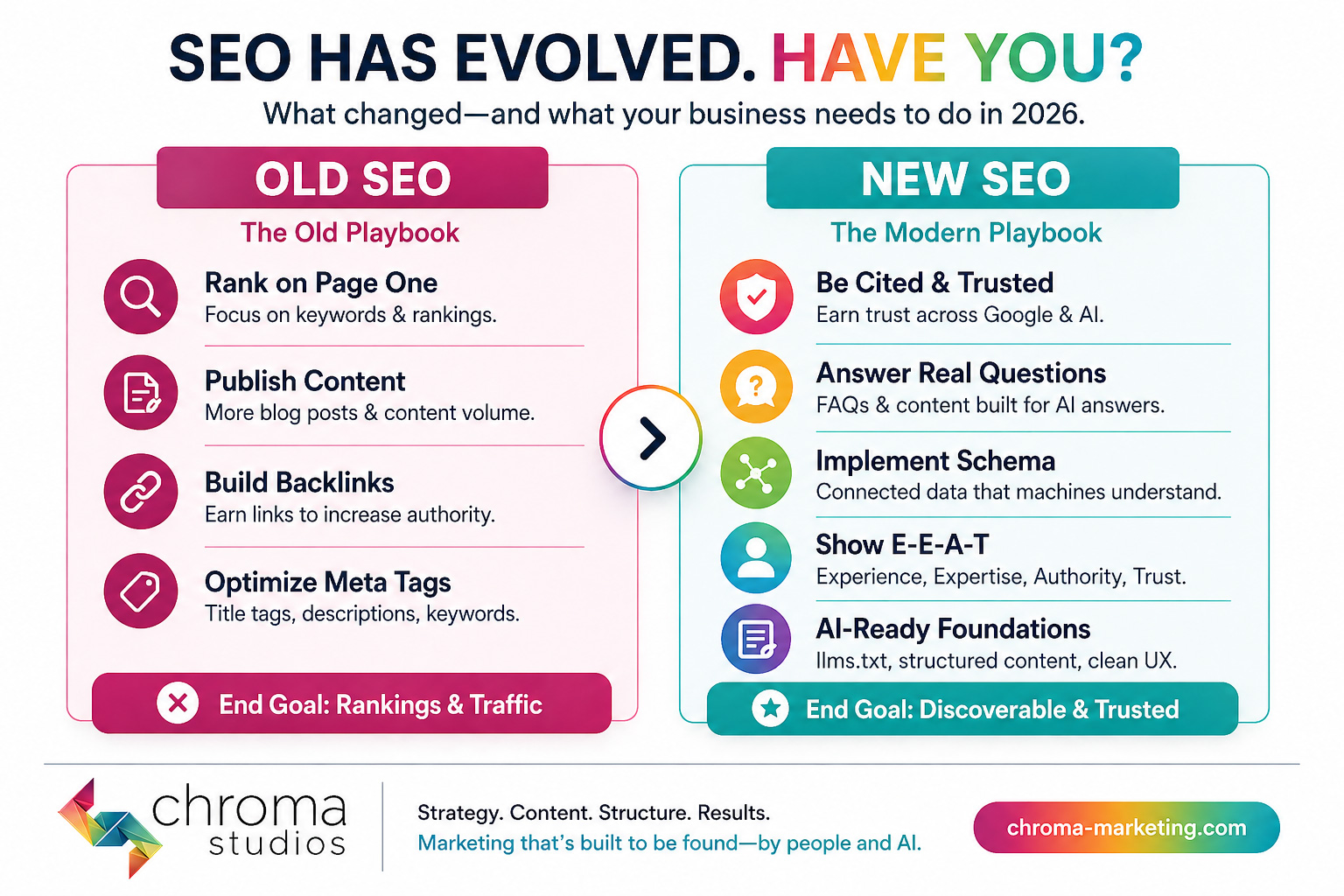
For years, a well-run SEO program came down to a handful of habits. You published long-form blog posts on a regular cadence. You filled in keyword-focused meta titles and descriptions. You organized your site around your products and services. And you trusted that quality plus consistency would eventually produce rankings.
That approach was correct. It built the organic authority your site has today, and we are not proposing to throw any of it out. What it cannot do anymore is operate alone. Google has grown more sophisticated about what “quality” means. An entirely new layer of search — AI-generated answers — now sits above the traditional blue links for a growing share of queries. The old practices still contribute. They are no longer sufficient by themselves.
E-E-A-T: The Quality Standard Behind Modern Rankings
Google now evaluates pages against a framework called E-E-A-T: Experience, Expertise, Authoritativeness, and Trustworthiness. It is not a single ranking signal you can dial up. It is the standard Google’s human quality raters apply when evaluating pages, and those evaluations shape the algorithm updates that follow.
The practical takeaway is straightforward. E-E-A-T rewards substance over volume. A deep, well-researched service page that covers the regulatory context, the standards involved, and the genuine first-hand experience behind your work does more for your rankings than three additional blog posts written to fill a calendar. For most of our clients, this is good news. The depth of expertise already exists. It just needs to be surfaced in your content rather than buried in your conversations with customers.
Answer Engine Optimization: The New Top Layer
A growing percentage of searches now returns an AI-generated answer at the very top of the results. Google AI Overviews, ChatGPT, Perplexity, and Bing Copilot all work the same way. The AI writes a direct answer to the question and cites a handful of source pages it considers most authoritative. Some of those queries never reach the traditional organic listings at all. The user gets an answer and moves on.
We call the practice of optimizing for these systems Answer Engine Optimization, or AEO. It sits on top of traditional SEO without replacing it. AI engines do not cite the longest page. They cite the page that is most clearly structured around the question being asked, that carries verifiable entity signals through schema markup, and that has earned enough off-site authority to be considered trustworthy.
In practical terms, AEO means writing content around the literal questions your buyers ask, not just around keyword phrases. It means structuring H2 and H3 headings as natural-language questions an AI engine can parse as question-and-answer pairs. It means adding FAQ sections to every major page, with questions sourced from real search-intent data rather than imagined ones. And it means giving the underlying machinery (schema markup, structured data, an AI crawler index) what it needs to recognize your site as a citation-worthy source.
 Schema Markup: The Invisible Layer That Now Matters Most
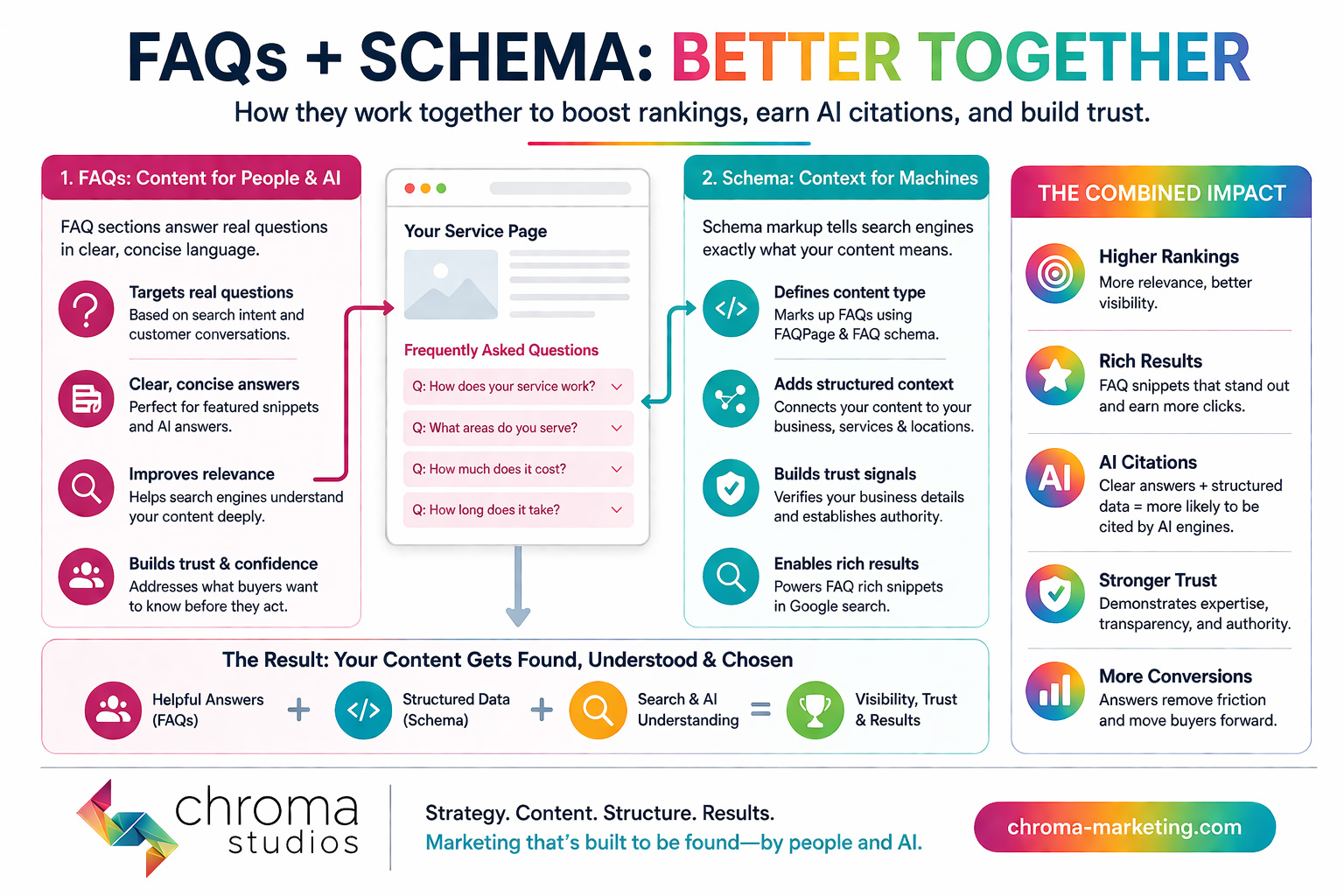
Schema markup is the structured data embedded invisibly in your page’s code. It tells search engines and AI crawlers what a page represents, not what it says. Without schema, a search engine has to read your text and make up its own mind. With schema, the answer is explicit. This page represents a specific service offered by a specific business at a specific verified address.
Modern schema is more elaborate than the basic Organization block most legacy plugins produce. A modern site links its homepage entity to its products, its services, its FAQ pages, and its verified Google Business Profile through a connected graph. Every entity references every related entity explicitly. That graph is what AI engines now look for when deciding whether a page represents something verifiable or something they have to infer from text alone. The gap between a basic schema setup and a full linked graph is one of the largest single differentials on a modern search results page.
FAQ Sections: The Highest-Leverage Content Element on Your Site
Four to eight well-chosen questions per major page, with concise answers of two to four sentences each, deliver three returns at once. They earn rich-result snippets in Google. They give AI engines exactly the citation material they prefer. And they address the specific questions that prevent a hesitant buyer from taking the next step.
The questions matter more than the answers. Good FAQ sections are not invented in a vacuum. They are built from research and the actual questions your team hears from customers every week. The language stays close to how buyers phrase questions, not how marketing copy phrases them. When the questions are written correctly, an AI engine parsing your page can lift a question-and-answer pair directly into a generated answer. That is exactly the outcome AEO is engineered to produce.
llms.txt: The Curated Reading List for AI Crawlers
The llms.txt and llms-full.txt files are a newer protocol that originated in the AI community. They sit at the root of your site and tell AI crawlers which pages are your most relevant and citation-worthy. Think of them as an XML sitemap written specifically for AI engines, with one important difference. They are curated, not comprehensive. Thin pages, paid-ads landing pages, and near-duplicates are excluded. The files focus the AI engines’ attention on the content that actually represents your authority.
Most small businesses and nonprofits have not yet implemented llms.txt. That is a competitive window that will narrow as adoption grows, but it is meaningfully open right now. Sites publishing a clean, categorized llms.txt and updating it with every significant new page are giving AI crawlers exactly the curated reading list they prefer. The reward, in our experience, is a measurable boost in citation likelihood relative to sites that do not.
Google Business Profile: Off-Site Authority for Every Business
Google Business Profile is often thought of as something only restaurants and home-service businesses need. That framing is out of date. In the current landscape, your Google Business Profile is the single most authoritative off-site signal AI engines have about whether your business is real, where it is, and what it actually does.
This matters even if you do not serve walk-in customers. When an AI generates an answer about your company, it pulls entity information partly from your website’s schema and partly from your Google Business Profile. A profile that is accurate, complete, and consistent with your on-site information gives the AI something clean to cite. A profile that is incomplete or mismatched gives the AI a reason to cite a competitor instead.
The single most important rule is NAP consistency. Your Name, Address, and Phone number must match exactly across your Google Business Profile, your website schema, your site footer, and your Contact page. Any discrepancy creates conflicting signals. A different suite number. A dropped punctuation mark. An old phone number lingering somewhere in an old footer. Each one chips away at Google’s confidence that your business is what it claims to be.
Reviews matter too, even for B2B and nonprofit work. The assumption that reviews are a consumer concern is a holdover from an earlier era. A procurement officer, a board member, a major donor, or a referral source will all glance at your star rating before they make first contact. A handful of thoughtful, named reviews outperforms zero reviews even when the underlying organization is equally strong. A sustained discipline of asking satisfied customers, members, or partners for reviews builds a profile that competitors without that discipline simply will not match.
Measuring What Actually Matters: AI Bot Tracking
One of the most useful additions to a modern SEO toolkit is an LLM Bot Tracker. For WordPress sites that takes the form of a plugin that logs every visit from an AI crawler (the bots operated by OpenAI, Anthropic, Google, Perplexity, Bing, and others) and reports them on a dashboard. It tells you total volume, recency, and which specific pages the AI engines are reading.
This is the missing piece of evidence that closes the loop on AEO work. Without it, you are implementing modern SEO on faith. With it, you have a monthly data point confirming that AI crawlers are visiting, that visits are trending in the right direction, and that the pages you built specifically for citation are the ones being read. On the engagements where we have installed this tracking, the data has been more persuasive than any traditional metric. An accelerating monthly count of AI crawler visits, broken down by operator and by page, is a new kind of evidence. It maps directly to the strategic question of whether your site is becoming an AI citation source.
What This Means for Your Ad Spend
A question we hear often is whether modernized organic search can reduce dependence on Google Ads. The honest answer is yes, gradually, as a trend rather than a guarantee.
The mechanism is straightforward. Google Ads buys immediate visibility in a paid auction. Every click costs, and every month the budget resets. Organic authority works differently. A site that ranks for a query, that is cited in the AI answer above the organic listings, and that appears with a rich-result FAQ snippet attached is earning visibility that does not expire at month’s end. Each month’s authority compounds the next month’s position.
The economics are asymmetric. An ads budget buys a month of attention. Investment in organic and AEO authority buys a long tail that grows rather than decays. Paid ads still have a real role for competitive pushes, new product launches, and short-horizon campaigns. But over time, organic and AEO performance can capture a growing share of traffic that previously required paid bidding to reach.
The Path Forward
The work described here is more comprehensive than the SEO maintenance most sites have in place today. The ground underneath search has shifted, and a modernized structure is what carries your existing content forward into the search landscape as it actually exists in 2026. Sites built correctly now earn visibility from Google’s traditional algorithms, from Google’s human quality raters, and from the AI answer engines that now sit above the organic listings.
Sites that do not modernize will still function. Legacy sites do not crash. But they will gradually cede ground to competitors that have done the work, at a pace that is difficult to see month over month and impossible to miss year over year.
If your business has earned good rankings under the old playbook, that authority is not at risk. It is the foundation everything else builds on. What needs to change is the structure around it.
About Chroma Studios
At Chroma Studios, we blend creativity, technology, and strategy to deliver stunning websites and custom digital marketing solutions. For 25 years, we have been committed to client success and community impact, helping our clients realize their goals and make a lasting difference.
Reach out to the Chroma team today to learn more about how we can modernize your search presence for 2026 and beyond. My name is Scot Noel, and I am Chroma’s Director of Content Strategy and Development. You can email me at Scot@Chroma-Marketing.com or call 724-523-3001.
