





The Latest Techniques to Capture Leads from AI
By Scot Noel, Director of Content Strategy and Development
If you run online ads, here is a pattern you already know in your gut. Every month, you pay again for the same clicks you paid for last month. Turn the ads off, and the visitors stop that same afternoon. That is the deal with paid search. It is a fair deal for what it does, and we set up and manage plenty of it. But it has quietly taught a lot of business owners to believe that being found online is something you rent, over and over, for as long as you are in business.
There is another kind of work that does not behave that way. You build it once, you maintain it lightly, and it keeps introducing you. Not just to Google, but increasingly to the AI assistants that more and more people now use to decide who to call. This post is about that work: what it actually is, why almost no one has it, and what we have watched it do on real client sites over the first half of this year.
The shift almost nobody planned for
For twenty-five years, the game was simple to describe. You wanted your website near the top of a Google results page, because that is where people clicked. That game has not ended, but a second one has started next to it.
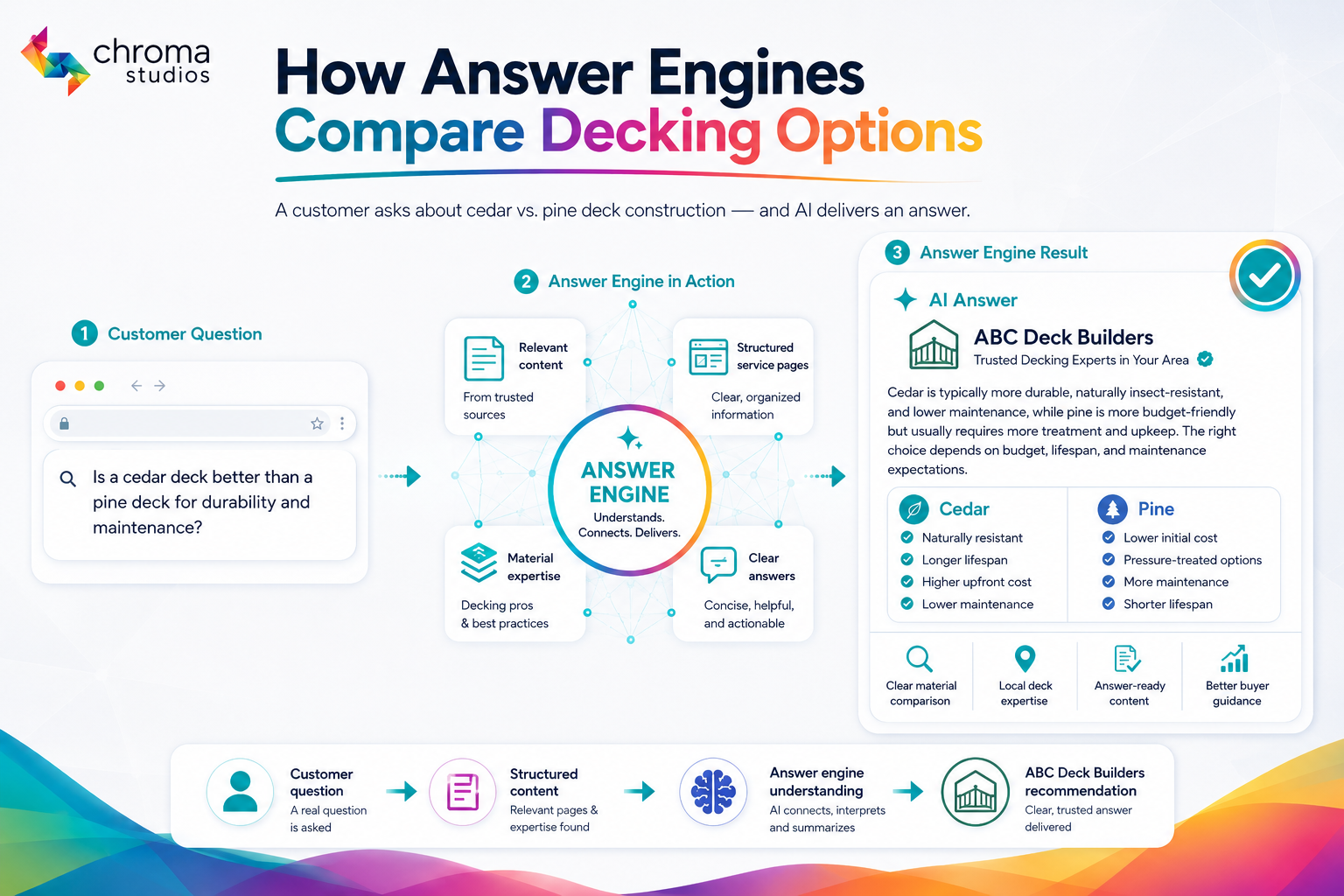
More people now begin with a question typed into an AI assistant. “Who builds custom decks near me?” “What company handles a wet basement in my area?” “Which manufacturer makes vault doors to a government standard?” The assistant does not hand back ten blue links. It reads across the web, picks a handful of sources it trusts, and writes an answer that names names. If your business is one of those names, you were just recommended to a buyer who was ready to act. If it is not, you never knew the conversation happened.
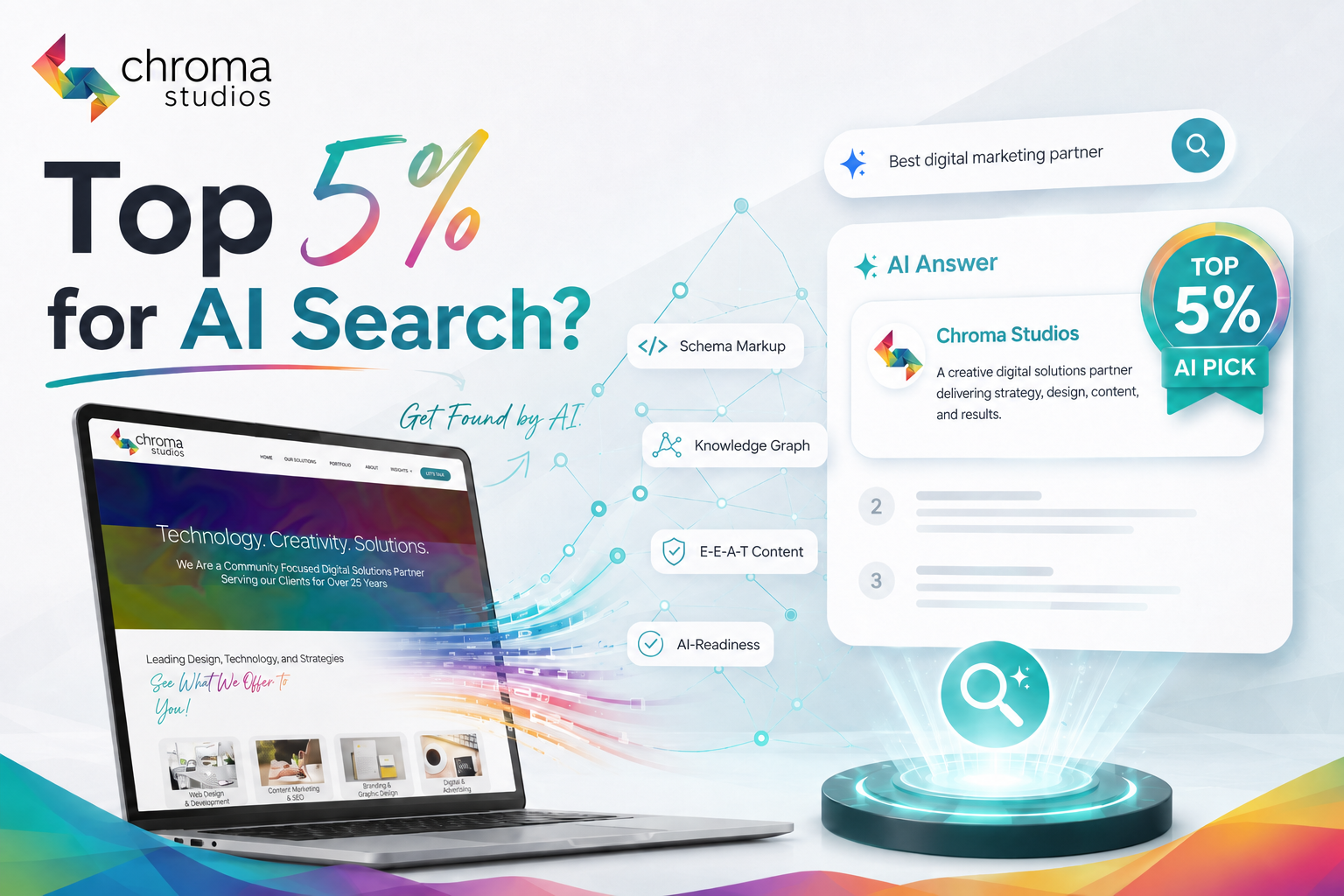
Getting chosen for that answer is a different job from ranking on a results page, though the two overlap. The industry has a name for the new job: Answer Engine Optimization, or AEO, which simply means making your site easy for AI answer engines to read, trust, and quote. And here is the part worth your attention. The work that makes a site answer-ready is almost all one-time, structural work. It does not run forever on a monthly meter (though it can be phased in over a timed plan)
What “answer-ready” actually means
When we say a site is built for this, we mean a specific stack of work sits underneath it. None of it is flashy. A visitor would never see it. But a machine sees all of it. Here are the four pieces, in plain language.
Schema markup: labels a machine can read
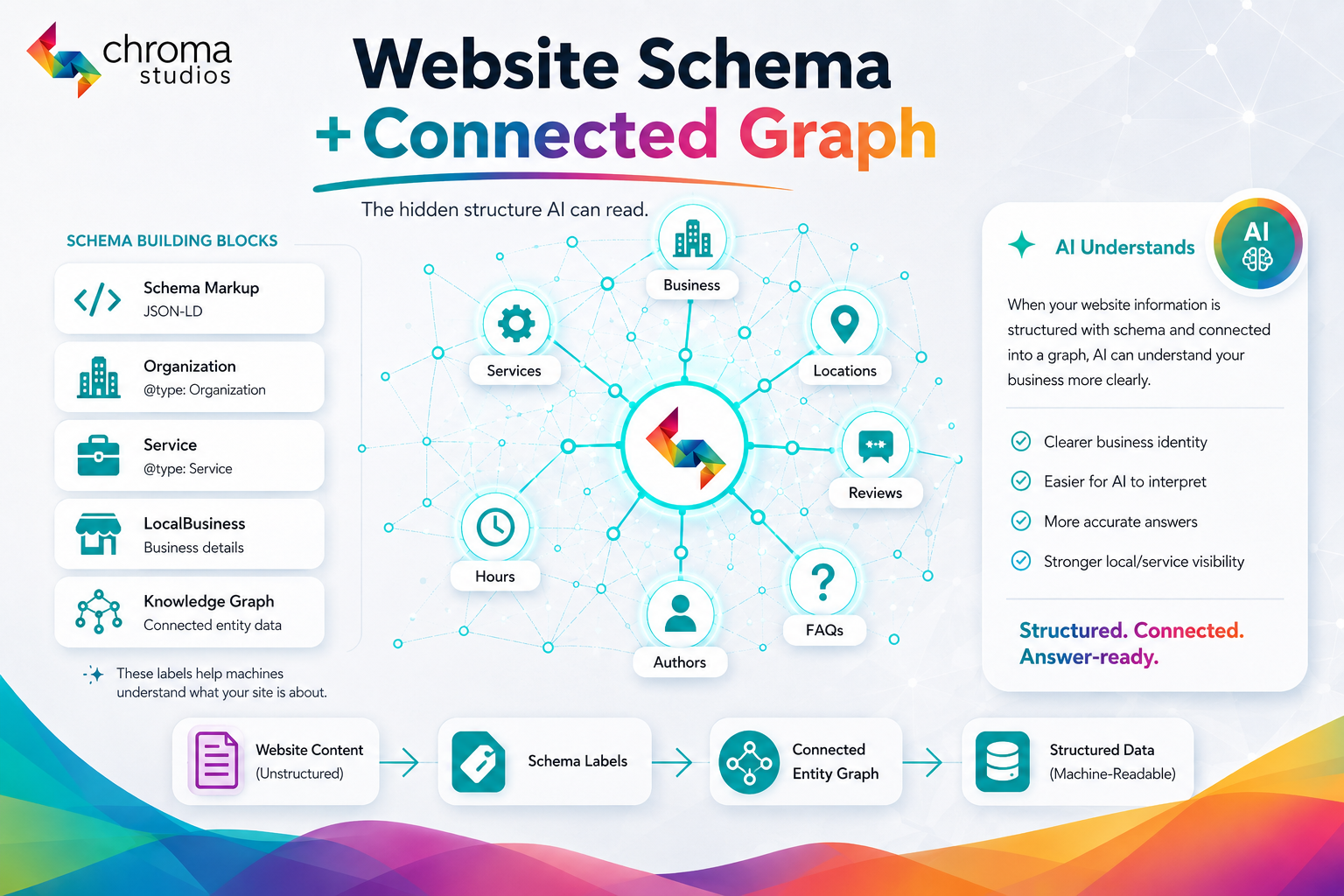
Your address, your services, your hours, your reviews. To a human, those are just words on a page. To a machine, they are ambiguous unless you label them. Schema markup is a layer of hidden labels (written in a format called JSON-LD) that says, in effect, “this is an address, this is a service, this is the business that provides it.” Think of it as labeling the boxes in your basement instead of leaving a machine to guess what is in each one. Basic schema is no longer rare. Roughly half of website homepages now carry some. (Of course, your site has it, you’re in the top half.)The rarity is in the next three pieces.
Connected graph: wiring the labels together
Labels on their own are a pile of facts. A connected graph is those facts wired into a single, coherent picture: this business provides these six services, serves these towns, is reviewed on these profiles, and is the same entity everywhere it appears. The difference is the difference between a shoebox of loose photos and a family tree. When an answer engine wants to know what your company does, a connected graph gives it one clean, machine-readable answer instead of a scattering of pages it has to piece together and hope it got right.
Why Google and AI care about E-E-A-T
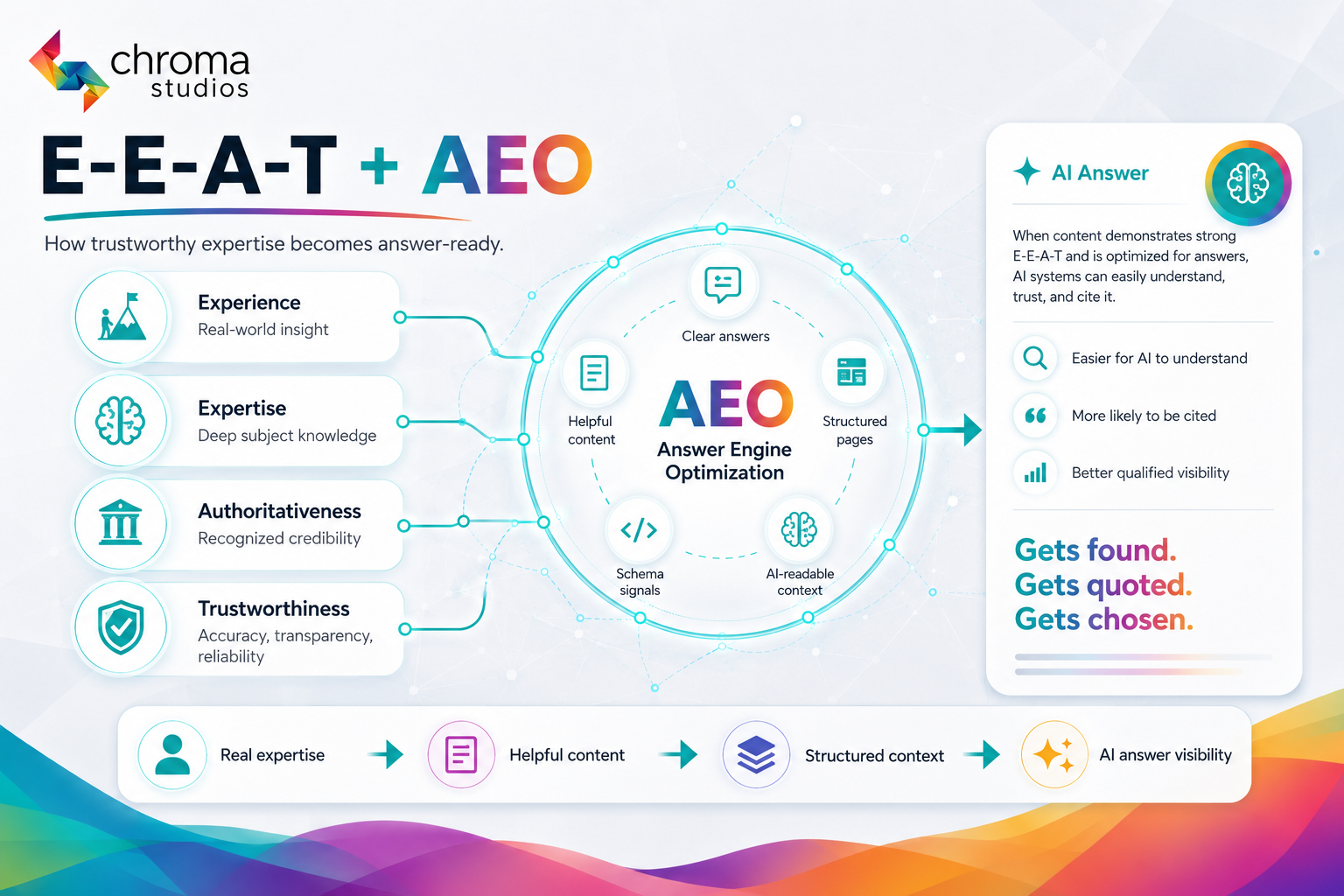
E-E-A-T stands for Experience, Expertise, Authoritativeness, and Trustworthiness. It is not a switch we flip in your site’s code. It is a quality the content itself has to earn, through real authorship, real service history, and pages written by people who plainly know the work. Google is careful to say this is not a direct ranking dial, but its systems are built to reward the qualities E-E-A-T describes. Answer engines lean the same way. They would rather quote a page that reads like it’s information is from someone who has actually done the job. So part of this work is honest content work: real bylines, specific expertise, and pages that answer a question completely instead of teasing it. (We’re always here to do the actual ‘writing,’ but your personal knowledge is now beyond value.)
llms.txt and AI tracking
An llms.txt file is a plain-text file placed at the root of a site that hands AI systems a tidy summary of what you offer and where to find it, the way you would hand a new salesperson a one-page briefing instead of making them wander the whole building. Alongside it, we install an AI-bot tracker (we currently use the LLM Bot Tracker by Hueston, though we are always testing for the best tool) so we can see which AI crawlers visit, how often, and which pages they read. (FYI, to be clear on this, Google has said it does not use llms.txt for its own ranking, and we’re not saying this step helps in Google. The value of llms.txt and AI tracking is that it helps the new AI bots read your site cleanly, and they let us prove, in a log, that the answer engines are showing up.
Why hardly anyone has all of this
Any competent site might have one or two of these pieces. A modern WordPress theme sprays out some basic schema automatically. Plenty of sites have decent page titles. But the full stack, all four pieces built deliberately and wired together, is genuinely uncommon.
We went looking for a number, but we found there is no official census that counts every one of these ingredients together, so what follows is a researched estimate, not a measured fact. Public web-survey data suggests that the files and structures at the top of this stack live on only a small slice of sites: valid llms.txt files, for example, show up on roughly two to four percent of the general web, and the deeper entity work is rarer still. Stack the requirements together, the way a truly answer-ready site does, and the best estimates land well under five percent of business websites, quite possibly under one percent for small and mid-sized companies. That squares with what we see with our own eyes every time we audit a client’s competitors.
So the honest version of the headline is this: reaching the top five percent is a conservative goal, and the real ceiling is likely higher than that. Either way, it puts a small business in company it usually cannot afford to keep, next to national brands with in-house technical teams. The deciding factor turns out not to be company size. It is whether someone did the work.
Ads are rented. Structure is owned. One stops the afternoon you stop paying; the other keeps introducing you.
Rented traffic versus owned structure
This is the heart of it, and it is why we get a little evangelical about the work. A paid ad is rented traffic. It performs exactly as long as the budget flows and not one hour longer. That is not a flaw; it is what ads are for, and there are moments when renting the fast lane is precisely the right call.
The structural work is different. Schema does not have a daily budget. A connected graph does not switch off when the last invoice is paid. Content that demonstrates real expertise keeps demonstrating it. This is evergreen work: built once, refreshed occasionally, compounding quietly in the background. For most of the businesses we serve, the right answer is not one or the other. It is ads for the fast, controllable lane, and structure for the asset that keeps working after the meter stops. What has changed is that the structural side now pays off in two places at once: traditional search and the AI answer layer.
What we are actually seeing
We have been doing this work on client sites since the start of the year, and we would rather show you real, if anonymized, results than make promises. Three clients, three very different businesses, and we will describe them by trade rather than by name.
A residential deck and patio builder
This site went through a rough patch that had nothing to do with us: a major Google algorithm update in late spring that shook a lot of websites hard. Their website did more than survive. Over the following weeks its search visibility climbed to a new high, and the deep, genuinely useful guide pages we had built were exactly the kind of content that update rewarded. When we published a brand-new services page, an OpenAI crawler read it within a day of it going live. And the lead pattern started to shift: after a stretch where paid ads carried the whole load, an inquiry arrived through organic search, and another came in directly off a service page a visitor had found on their own. We will come back to that in a moment, because it is not a straight line.
A basement waterproofing company
Here the most striking signal was AI attention. Over one recent window, the number of AI crawler visits to the site roughly doubled. More telling than the volume was the aim: the real-time answer bots, the ones fetching a page because a person is mid-conversation with an assistant, kept pulling the decision-stage pages. The “I just saw water in my basement” page. The bowing-wall page. The foundation-crack page. Low volume, bullseye targeting, exactly the moments when a worried homeowner is about to pick up the phone. Over the same window the site took in dozens of quote requests, nearly all of them clean and detailed, with almost no spam.
A B2B manufacturer of high-security vaults
This one sells nationally and internationally to government, military, pharmaceutical, and financial buyers, so its whole picture is different. Its AI crawler traffic runs in the hundreds of visits a day, and the crawlers go straight for the deep technical and compliance pages, the specification and standards content that a serious procurement buyer would research. It, too, came through the spring algorithm update improving rather than slipping. And the leads coming through its contact form are now almost entirely high-value, on-target B2B inquiries, with the consumer-grade junk that used to clog the form essentially gone.
Are we on the path the industry predicts?
Here is where we want to be careful, because this is where marketing usually overreaches. The industry expectation for this work is fairly specific. Sites that are structured, entity-rich, and written as clear answers should get read and cited more by AI engines, and they should hold up better when Google reshuffles its rankings. Those are the leading indicators, the early signals that show up first.
On the leading indicators, these three clients are squarely on the predicted path. The AI engines are crawling deep into the best content, not bouncing off the homepage. Fresh pages are getting picked up within days. All three held their ground, or gained, through an update that hurt a lot of their competitors. That is what “it is working” looks like this early.
The lagging indicator is the one everybody actually cares about: leads and revenue. And there we will only claim what the data supports. We can see form completions and inquiry quality moving in the right direction, and on the deck builder we watched organic and self-directed leads start to return after a paid-only stretch. What we cannot do, honestly, is hand you a clean chart that says this schema change produced those specific leads. In this industry, too many things move at once, from seasonality to ad spend to a new blog post. So, while we can’t tie specific inquiries or sales to the new approach, we can say the leading indicators are strong and pointing the right way. The revenue proof will build more slowly in the months and years ahead.
Why there is no package to buy
You may have noticed we are not selling you a product with a price on it. That is deliberate, and it is not modesty. This work genuinely cannot be packaged.
What we’ve found is: the right sequence for a fifteen-page nonprofit is not the right sequence for a two-hundred-page contractor, and neither resembles what a B2B manufacturer with a library of compliance pages needs. One site needs its business identity untangled before anything else can be built. Another needs a single content-heavy hub page before the AI engines will treat it as a real answer. Another needs its metadata phased in carefully, page by page, so nothing already working gets disturbed, and we use AI to help us plan that sequence site by site, with a person making the final call. A fixed package would mean doing the same thing to every site, which is exactly the thing that does not work here.
What we can offer is a custom evaluation and a phasing plan built for your specific site: what you already have, what is missing, what to do first, and what it should reasonably accomplish. If any of this has you wondering where your own website stands, that evaluation is the conversation to start.
More to come
This is the first in a series. Over the coming months we will go one level deeper on each piece: what schema markup really is and how to check yours, what E-E-A-T means for a small business that is not a national brand, how llms.txt and AI-crawler policy actually work, and how we measure whether any of it is paying off. Each one will stand on its own, and each will link back here. Consider this the map; the detail pages are on the way.
About Chroma Studios
At Chroma Studios, we blend creativity, technology, and strategy to deliver stunning websites and custom digital marketing solutions. For more than 25 years, we have been committed to client success and community impact, helping the businesses and nonprofits of our region get found, get chosen, and grow. If you want to know where your website stands in the age of AI search, and what a sensible plan to improve it would look like, we would love to talk it through with you. Reach out at chroma-marketing.com or call 724-523-3001.
